The rhythm of the island
Mykonos lives less like a city than like a resort running a very dense five-month programme. The day starts late here: until noon the island sleeps, by one o'clock the beach clubs fill up, and six or seven in the evening brings the main hour — the sunset, for which Paraga and Panormos put DJs on the decks. Dinner in Chora begins at ten or eleven, the bars gather strength around one in the morning, the clubs at Paradise run until dawn. A client used to Moscow or Dubai timing is usually three hours out on his first evening — we warn about that in advance.
Our own schedule follows from this. Peak load on Mykonos is double: daytime from 13:00 to 19:00, when the beach-club bookings and sunbed accompaniment run, and night-time from 23:00 to 05:00. In July and August there is almost no difference between weekdays and weekends — the island is full all week. In May, June and September the curve is normal: Thursday to Sunday dense, Monday to Wednesday calm, matching quicker and the choice wider.
Clients on Mykonos fall into three types. The yacht crowd: the island sits on the Cyclades route, boats put in at Tourlos or drop anchor off Ornos, and the party comes ashore for two or three days. Hotel guests: flown in for a week at the Belvedere, Cavo Tagoo or Santa Marina, living the beach club — dinner — bar loop. And the short weekend run from Athens, Istanbul, Dubai or Milan: two nights, one evening in Chora, one day on Psarou. Each type has its own matching logic and its own planning horizon.
The season: May to September, and the honest version of winter
The season on Mykonos opens in May and closes at the end of September or the beginning of October. May and the first half of June — mild weather, the water still cool, the clubs running at half power, prices lower across the board and the service more attentive. Late June, July and August are the peak: the island is packed, the roads jam, a table at Nammos or Scorpios for an August evening is booked weeks ahead, not a day ahead. September is the best month for the balance of weather and crowd: warm sea, thinning numbers, long evenings.
We are straight about winter, because it is the first thing worth knowing when you plan. From November to March Mykonos is effectively closed. Most hotels go into hibernation, the beach clubs dismantle their structures until the following May, and only a handful of restaurants stay open — a few tavernas and cafés in Chora where the locals eat. Ferry traffic thins out, part of the flight schedule is dropped, and what remains is the connection through Athens. We do not pretend there is a programme on the island in winter: if a request comes in January, the manager says plainly that the format will be a quiet one — hotel, dinner in Chora, a low-key evening — and that Athens or another city in the network is more interesting at that time of year.
One more island detail is the meltemi, the northerly wind that blows for several days at a stretch in July and August. It redraws plans: the northern beaches, Ftelia and Panormos, are uncomfortable on windy days, while the southern ones — Psarou, Paraga, Platis Gialos, Ornos — sit in the lee. The meltemi also delays ferries and keeps tenders from coming in to shore, so on those days we move a pick-up from a yacht onto dry land in advance rather than at the last minute.
Where we work
Chora (Mykonos Town) is the heart of the island and our main evening point. The Kato Mili windmills, Little Venice with houses standing straight over the water, the maze of streets around Matogianni full of restaurants and bars. Dinner is here, the bars are here, and our hotels are within walking distance — the Belvedere in the School of Fine Arts district, Cavo Tagoo at the northern entrance to town, Bill & Coo above Megali Ammos bay.
Psarou is a small sheltered beach five kilometres from Chora, home to Nammos and the Mykonos Blu hotel. The most expensive strip of sand on the island and the principal daytime address: lunch at a table by the water, champagne, front-row sunbeds, tenders coming in from the yachts straight to the shore.
Paraga is the neighbouring bay, where Scorpios and SantAnna operate side by side. Scorpios is about the sunset, the drums and the DJ set on the wooden deck; SantAnna is about an enormous seawater pool and a daytime programme. Two different logics on one beach, and clients usually pick one of them for the whole day.
Panormos and Ftelia are the north shore. Principote at Panormos — white canopies, long lunches, music until sunset. Alemagou at Ftelia — the most relaxed format on the island: timber, straw, cooking without the fuss. Both catch the meltemi, but neither ever gets the crush you find in the south.
Ornos is the family and hotel bay four kilometres from Chora: Santa Marina with its own beach and jetty, Kenshō, Kalesma up on the Aleomandra hill above the bay. It is a convenient base for both the beaches and Chora. Platis Gialos is the transport hub of the beaches — the sea taxis to Paradise, Super Paradise, Agrari and Elia leave from here.
Paradise and Super Paradise are the club zone. Cavo Paradiso, on the cliff above Paradise, has been running through the night since 1993 and closes its programme around dawn. It is a loud format, for a particular scenario and a particular client; we brief the model in advance on exactly where we are going.
Tourlos is the new port two kilometres north of Chora: cruise ships, the large ferries, the marina for yachts. The old port in Chora itself takes tenders and small boats. Trips off the island — Delos (thirty minutes by boat, an ancient archaeological site under UNESCO protection), Rineia for swimming, Paros, Naxos and Santorini by yacht or fast ferry, Athens forty minutes away by plane. All trips are agreed in advance, a day ahead at minimum, and the ones by sea several days ahead.
Logistics: airport, ferries, yachts
Mykonos airport (JMK) sits four kilometres from Chora. In winter it means one runway and a few flights through Athens; in summer, direct routes from the European capitals and very heavy private-aviation traffic — aircraft come in from Nice, Geneva, Milan, Dubai, Istanbul. The drive from the airport to Chora takes ten to fifteen minutes, though on an August evening at peak hour the narrow island roads can easily turn that into forty.
Ferries run from two Athens ports. Rafina is closer to the Athens airport — the fast boats reach Mykonos in roughly two and a half hours. Piraeus is two and a half to five hours depending on whether you take a high-speed vessel or a conventional car ferry. In summer the timetable is dense, but it answers to the wind: in a strong meltemi crossings are cancelled, and that is worth factoring in if the evening is planned to the minute.
Plenty of people arrive under their own steam: Mykonos sits on the Cyclades route — Athens or Rafina, then Mykonos, Paros or Naxos, then Santorini. Yachts berth in the Tourlos marina or anchor off Ornos, Psarou, Platis Gialos and Panormos, with guests coming ashore by tender. For us that is a separate piece of coordination: the model arrives at the quay and boards at the crew's invitation.
Taxis on the island are few, and in summer that is the bottleneck — we always suggest a private driver. In August it is the difference between "we arrived at nine" and "forty minutes stuck outside Ornos".
Etiquette and dress code
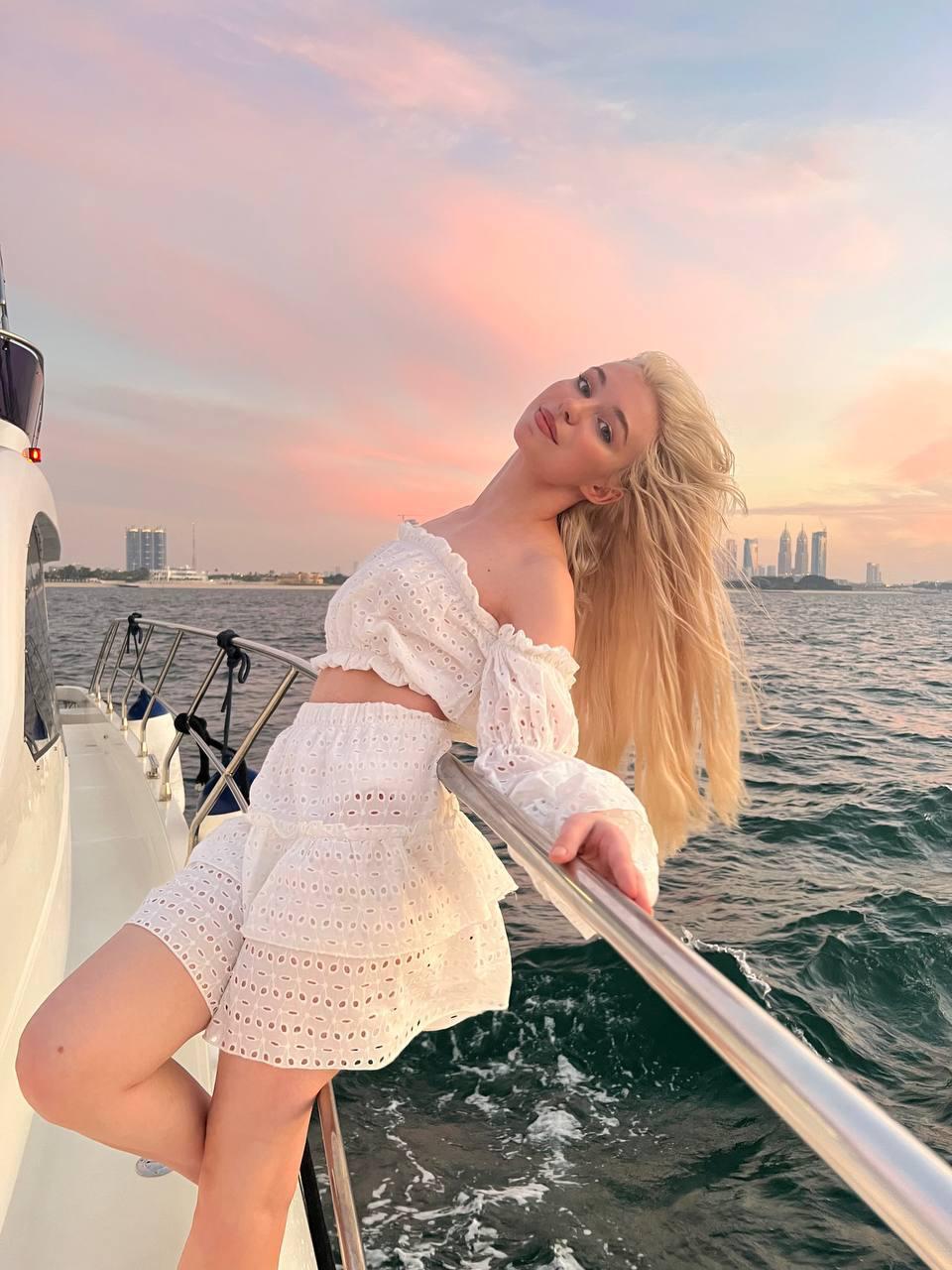
Mykonos is an island without jackets, but with a very visible code all the same. By day at Nammos, Scorpios, Principote and SantAnna it is designer beachwear: a kaftan dress over a swimsuit, flat sandals, a straw hat, minimal jewellery and good sunglasses. The daytime look is read faster here than the evening one — it is the island's main shop window.
The evening in Chora is a different format, and one detail decides everything: the paving. The streets of Chora are stone and marble, polished to a shine and slippery by nightfall. Stilettos do not work on them, and models who have been here before come to dinner in stable shoes — flat sandals, a low block heel. We spell this out separately in the briefing before a meeting in Little Venice or on Matogianni.
By venue: Matsuhisa at the Belvedere and the Bill & Coo restaurant are evening smart casual — a dress, a tidy look, nothing beachy. Interni on Matogianni and Kiku in Chora are the same, a shade looser. Hippie Fish at Agios Ioannis is a lunchtime beach format — a long light dress over a swimsuit. Astra on Matogianni is a bar with history going back to 1987, evening island code, and you can go brighter here. Bonbonniere is Chora's late-night format. Cavo Paradiso is the club, closer to sunrise.
Hotel and club staff on Mykonos have worked with an international crowd for decades and ask no extra questions. A correct arrival is a simple thing: calm, at the agreed time, no luggage, the visit arranged beforehand. In the beach clubs the model gives the name on the booking and joins you at the table rather than hunting for you across the terrace.
Straight talk about working on Mykonos
The minimum slot is 2 hours. We take nothing shorter anywhere in the network, and on Mykonos it is physically pointless on top of that: in August the drive from Chora to Panormos will eat half the slot. The island's real format starts at four hours, more often a full day or several days, because the scenario here is naturally long — the club from lunch to sunset, then dinner, then a bar.
Base pricing is from €1,500 for 2 hours and €2,000 for 4 hours. The media segment is a separate pool and separate pricing: from €3,500 for 2 hours and €5,000 for 4 hours. A night, twenty-four hours, two days and trips off the island are on request — we do not publish figures for those formats, because on Mykonos they depend far too heavily on the date, the logistics and the duration. Payment — cash (EUR, USD), bank transfer, cryptocurrency by agreement.
Planning is the thing we warn about most. July and August book out ahead across the board: hotels, tables, sunbeds, boats. We will take and work a request for "tonight, 10 August", but we will say honestly that the choice will be narrow and that a particular table at Nammos that evening is most likely out of reach. The same request two weeks out closes without any drama.
Sharing a model's photographs with third parties is not permitted. We do not haggle after a meeting. Mass events without a personal client are not our format. These boundaries are the same across all 58 cities in the network.
The APEX team
Names stay private — this is what our clients value. What we can show is roles, scope and the work each person does in your scenario.
APEX expert for Mykonos
Local specifics · venues · routes
Knows the Mykonos hotel and restaurant scene firsthand: which reception will be discreet, which maître d' to call directly, which dress code holds for which venue. Brief any new model joining the Mykonos pool.
Direction manager
Telegram · WhatsApp · 24/7
On shift in chat. Replies within the first three minutes. Holds the full picture of the day: who is free, who fits the scenario, what is booked at which venue. The first person you talk to.
VIP client curator
Returning clients · long-form scenarios
Works with returning clients on a personal basis. Holds preferences, scenario history, the small details that make the second meeting easier than the first. Manages weekend and travel formats.
Cultural programme coordinator
Theatre · opera · receptions
Holds the box-office contacts for the city, knows the dress codes by venue and by event class. Briefs the model when the scenario includes a premiere or a closed reception.
Travel and event specialist
Out-of-city · weekend · international
Coordinates trips beyond the city: visa timing, transfer logistics, accommodation, on-site fixers when needed. Plans 2-7 day formats and inter-city moves.
Where we are
Building
APEX Liaison — Mykonos Town
Address
Matogianni, Chora,
Mykonos,
84600
Hours
24/7 in season (May-October); November-April on request
This address in Chora houses the coordination point for the seasonal shift. Meetings with companions take place at hotels in Chora, Ornos and Psarou, at the beach clubs of Paraga and Panormos, on yachts at Tourlos and at villas rented by clients — not at this address. Communication runs through the Telegram manager.
Open in Google Maps →